
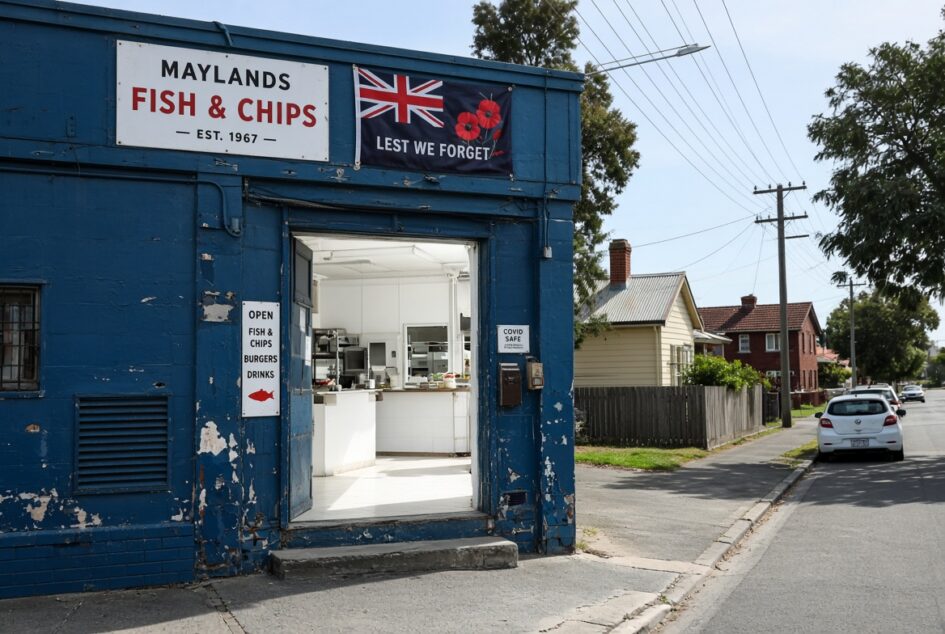
The fish and chip shop had a Lest We Forget flag pinned above the door.
That’s why we stopped.
When I went in, the store was small. Outside it was a light marine blue, and inside it was painted and repainted white. It had no picture menus hanging above the counter. Instead there were a few laminated menus near the till.
The owner was a mature white male who wanted to talk about politics.
“When I opened this shop, I had three governmental regulations that I had to address. Now I have twenty, and each costs over a thousand dollars. Then recently my wife was ordered by the health department to complete a TAFE food-handling course that cost three thousand dollars, in order to do the job she’s been doing for ten years.”
“In those ten years,” I asked, “how many people have you two killed with your untrained food-handling skills?”
“Zero,” he laughed, “and now they’re insisting that I do it as well.”
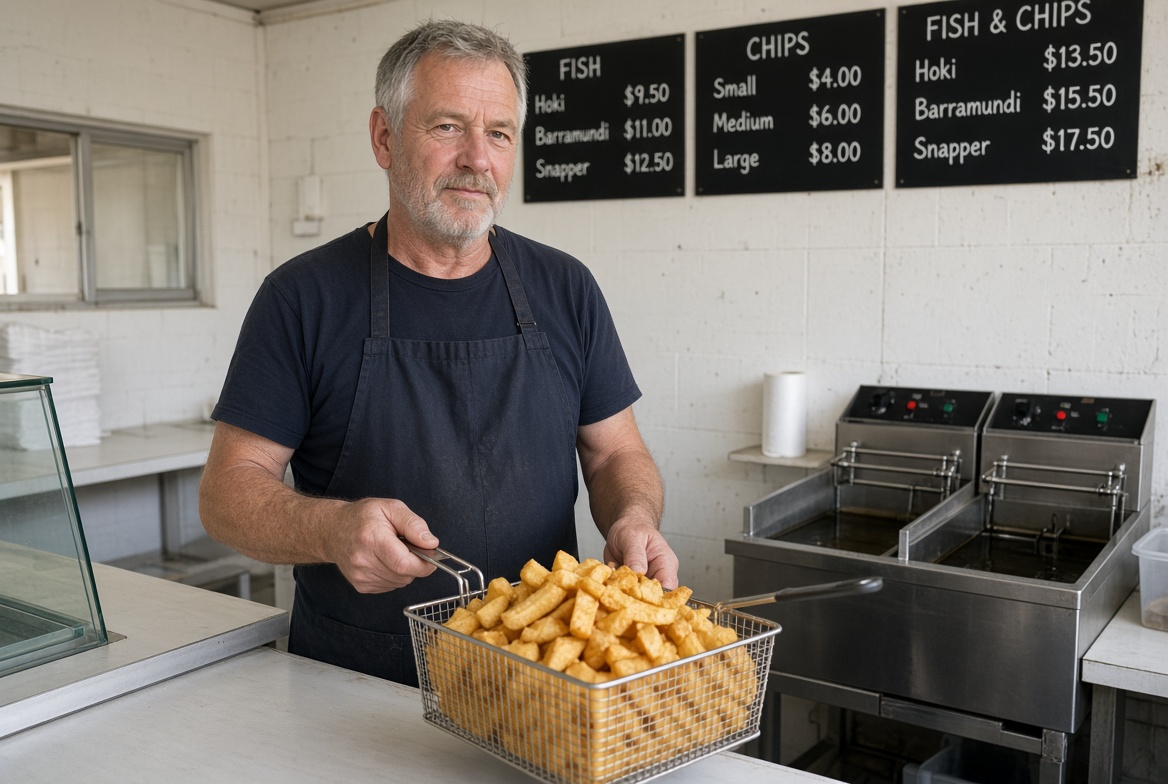
As the fish fried in the fat, he went on to talk about Covid and the jabs, which he felt he was forced to take. “A twenty-grand fine if I didn’t,” he said. “A lot of other businesses here closed down because they didn’t want to take it, and now they are gone. But twenty grand.”
“This country is dead,” he said, as he threw the chips into their basket and then into the deep fryer.
“You know, in this entire block, I’m the only white store owner. It’s dead,” he said. “The Australia we loved, it’s gone. That’s why, after fifteen years, I’m going back to New Zealand. I mean I love Australia,” and he emphasised the word “love” like it was a splinter he didn’t want to pull out of his soul, “but what’s the point of being here if you can’t make a quid?”
“Plus, when I sell the place, and I want to, this fucking government is going to take half. Half! For what? They never helped me once. In fact all they did was get in the way, and now they want half.”
“And another thing, they’ve never run a business. Any of them. At least Pauline has.”
“You think she’s the answer?”
“I like her, but she’s not a leader. She’s like the battering ram. She’s the one that could break through, but after she does I hope Barnaby takes over.”
“And if Labor wins?”
“Then we’re fucked . . . That’s it, we’re fucked.”
Then I left with two small pieces of shark and regular chips.
“Forty bucks, are you kidding me!” my partner Kel said.
“And it’s shark,” I said, “which is the cheapest.”
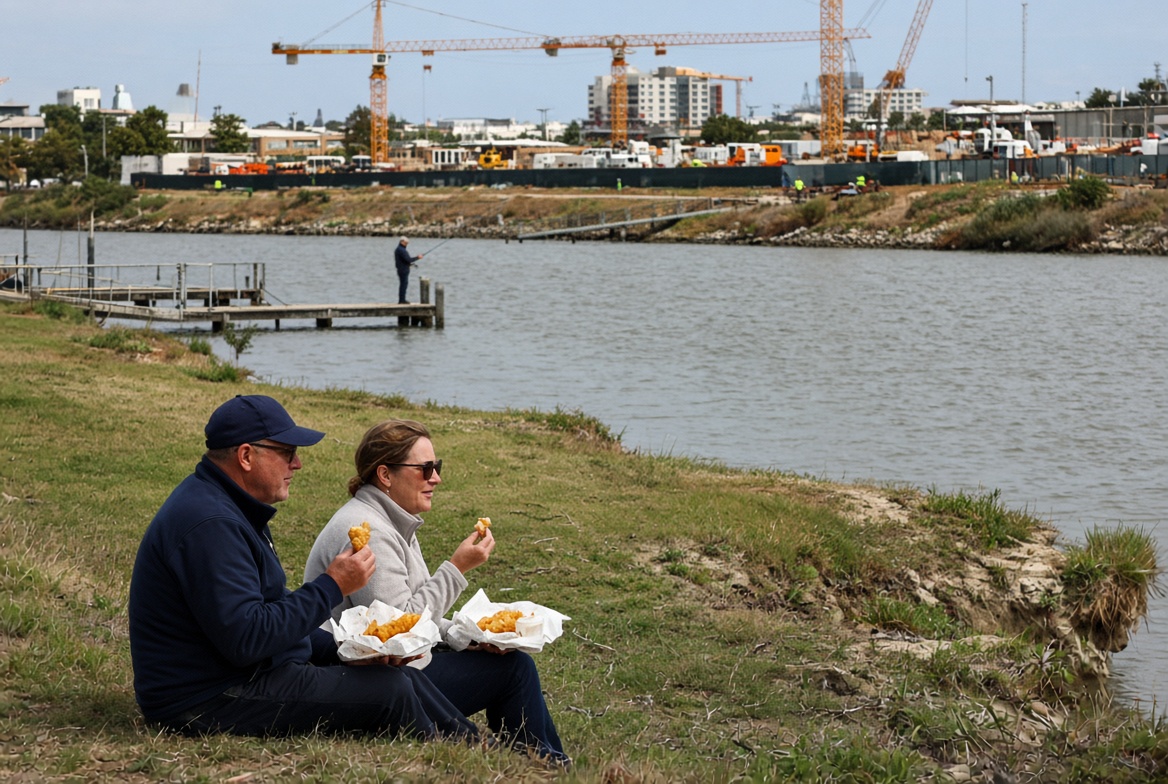
We drove a little forward and ate near the Swan River.
On the other bank an enormous building project was underway. There were cranes and trucks and scores of tiny people in high-vis walking around.
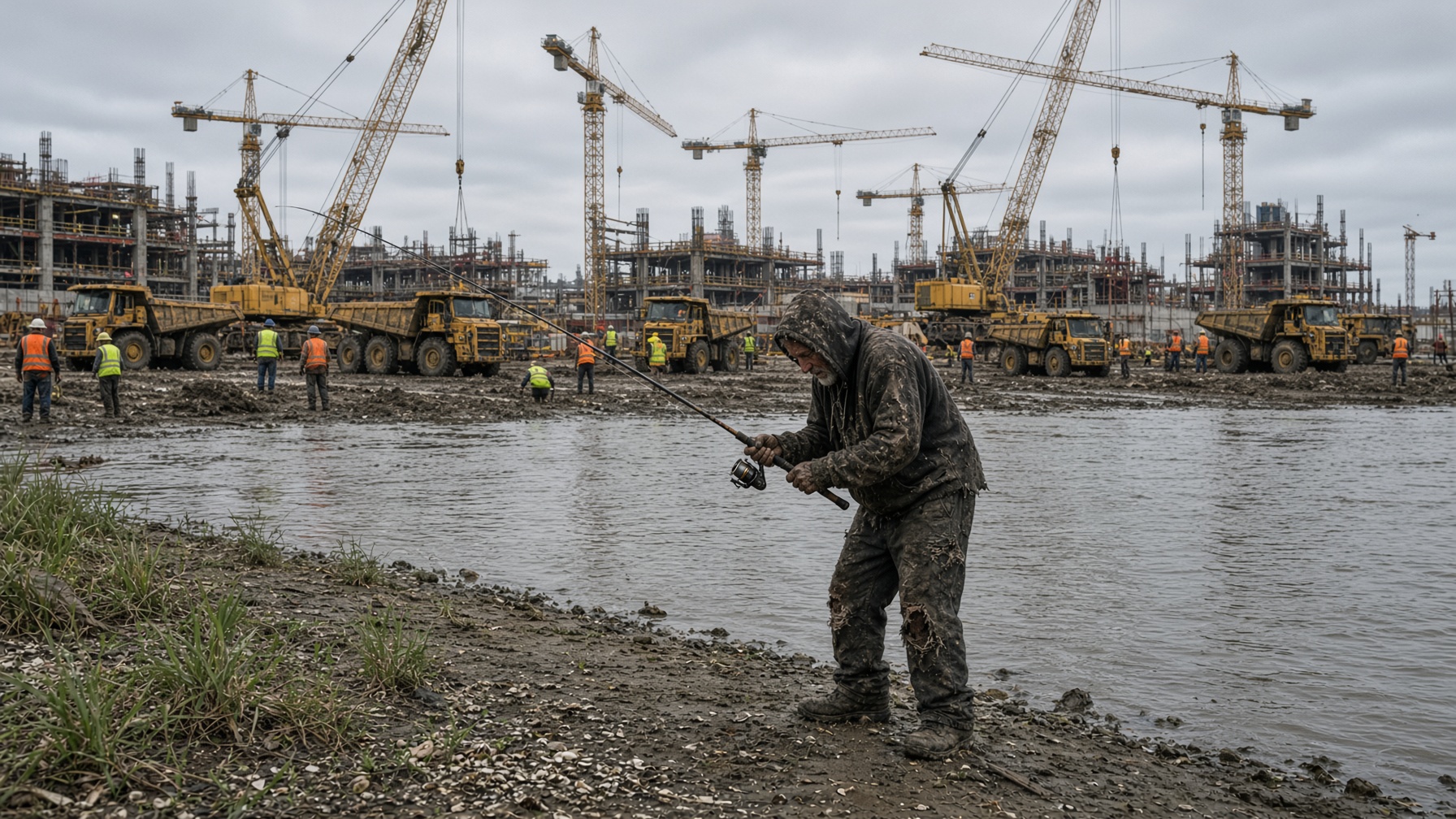
On this side of the bank there was a tiny jetty with two fishermen, separate upon it. Then, as we ate, one of them, a mature white guy, skinny as a whippet, kept his hoodie securely up as he left the jetty to try his luck casting his little rod into the river from the bank.
He had no other fishing gear than the rod. No tackle bag, no foldable seat, no friend. Instead he had an agitation that was never clearer than when we watched him lift the hook into the air to find a frond of water plant hanging off it.
“He’s hungry,” Kel mused, as we watched him cast the cleared bait back into the water that the incoming tide was driving in, as though, out of all of us, at least the current knew where it was going.
That night we slept in a large carpark in Balcatta, because there was a gym nearby, which was where we did a workout and had a shower.
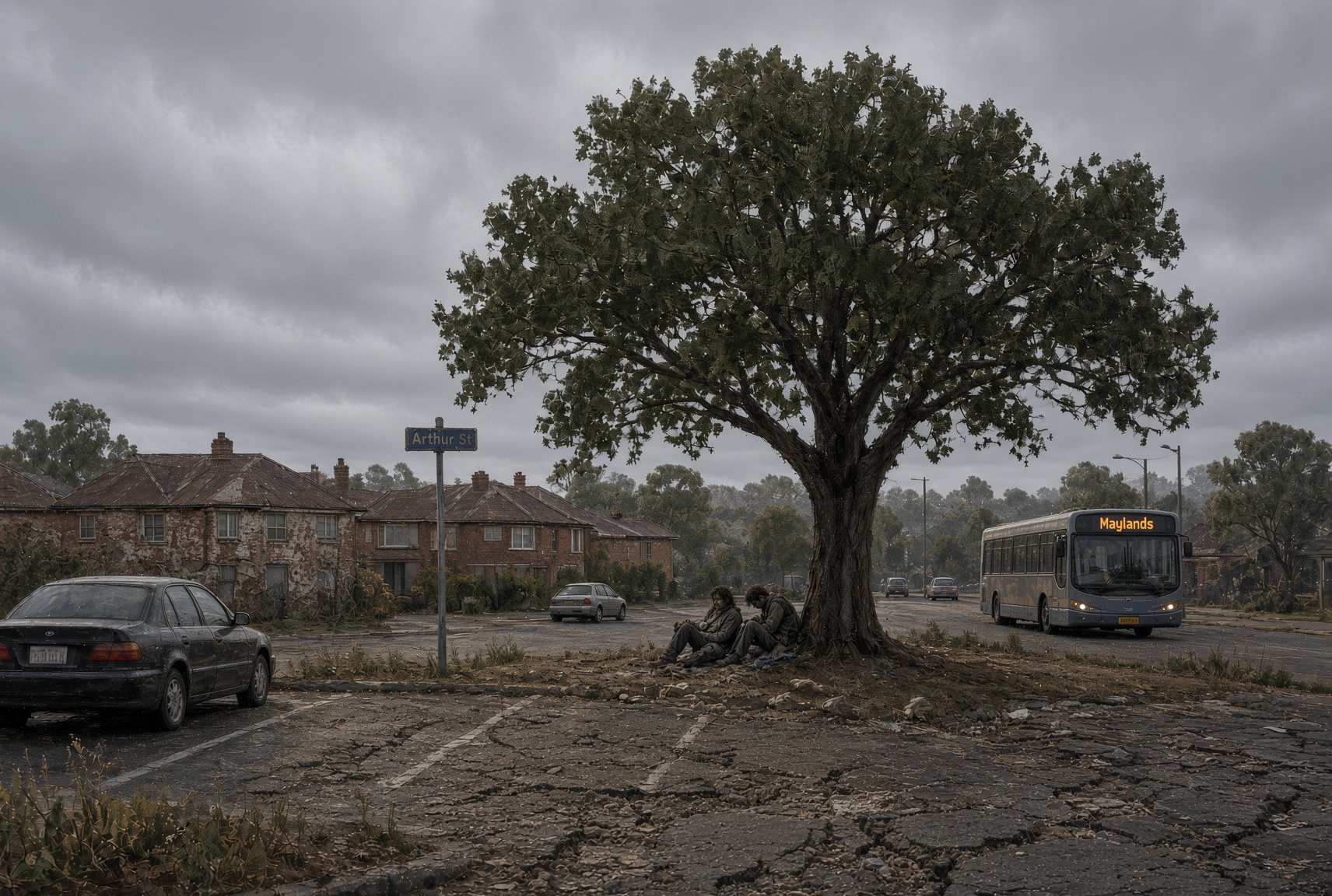
As the Western world continued to rapidly decline, online, we watched the sun create treasures out of a street of brick and tiled houses, our bus, and the tree.
We had some work to do and an appointment in the afternoon, and since it was quiet and the gym was close, we stayed.
Around 11 am an Indian security guard knocked on the door.
He informed me that this was a private carpark, to which I replied, “where are the signs?”
We went on to chat about what we do, and he went on to warn us that this carpark was a known shooting-up gallery. He even showed me images of junkies shooting up under the aforementioned tree.
They looked like two white mature males, both concentrating on whatever they were shooting into their arms.
He then told me that he wouldn’t be back until Monday morning, so if we wanted to stay here we could, but Monday they would have to fine us.
He was tall and well-manicured and always polite and respectful. Even his high-vis vest was neat and clean.
I went on to talk about how the country was changing, economically and demographically, but he looked a little lost with what I was saying, yet out of politeness, he nodded as he tried to follow.
Finally he offered me his hand, and then said, more to himself than to me, that Perth was a beautiful city. In fact his words were more precise than that. His actual words were, “It’s the most beautiful city I have ever seen.”
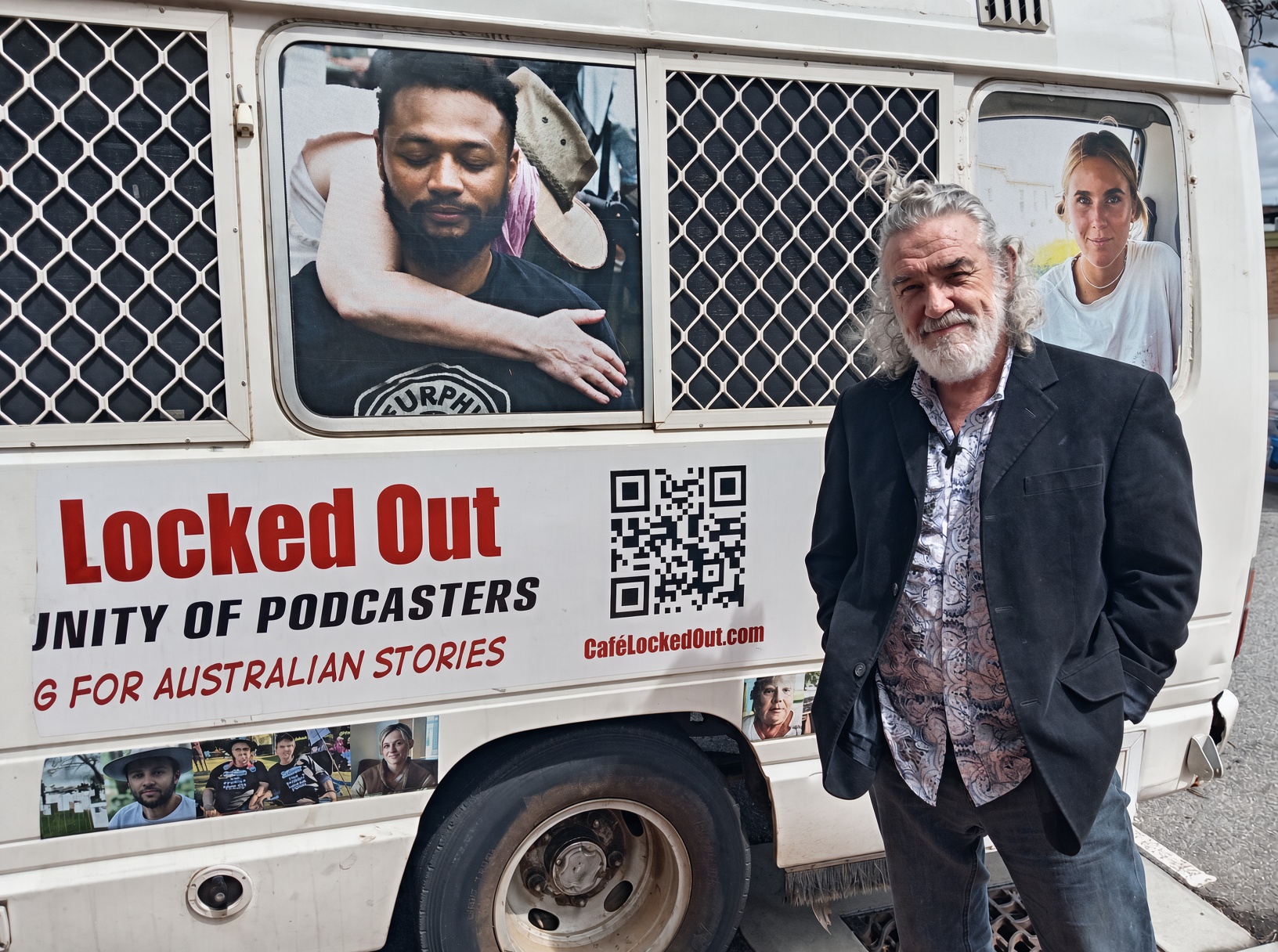
Michael Gray Griffith: Café Locked Out.
Maylands, Western Australia. October, 2026.
Further Reading
Michael Gray Griffith is the author of Goodbye Road: Australia’s Broken Heartlands.
You can purchase signed copies of the book here:
And you can read the Introduction to Goodbye Road: Australia’s Broken Heartlands by John Stapleton, editor of A Sense of Place Magazine, here:

Leave a Reply