
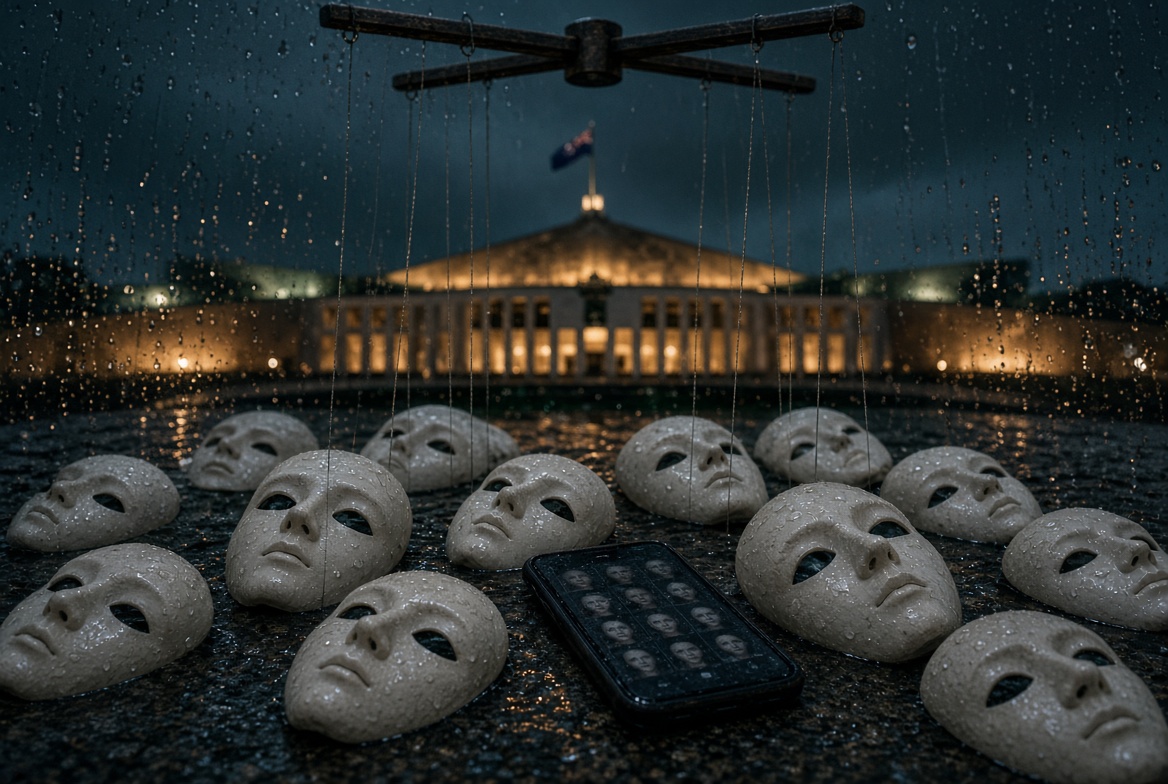
For most Australians, a sock puppet is a homemade toy. Online, the term means something else entirely. A sock puppet account is a fake identity created by someone who already exists on the internet. The operator pretends to be another person — often to praise their own views, attack critics while staying hidden, or manufacture the appearance of popular support. It is deception by design.
The Albanese government’s exposure draft of the Online Safety Amendment (Digital Duty of Care) Bill 2026 would give that power, with legal immunity, to the eSafety Commissioner, currently Julie Inman Grant, a woman closely aligned with the World Economic Forum.
Released on 8 September for a short public consultation that closed on 22 September, the draft sits inside a much larger rewrite of online regulation. It would impose a statutory “digital duty of care” on a wide range of services — social media, search engines, app stores, messaging platforms and AI tools — requiring them to provide a “safe online environment” so far as is reasonably practicable.
Penalties could reach more than $100 million. Buried in Division 3 is the sock-puppet regime.
The potential for the political manipulation of online narratives is obvious. The proposed laws have been roundly criticised both in Australia and around the globe.
Research fellow at the Institute of Public Affairs Margaret Chambers says: Sock puppets are “a well known intelligence and information warfare technique.” The AI generation power is “an effort by the government and eSafety Commissioner to engage in information warfare.” “Rules for thee but not for me.” The Commissioner’s version of “online safety” is “ideological and extends to censoring political debate.”
The highly regarded American journalist Michael Shellenberger: “The censorship industrial complex is going on the offensive. New legislation being field tested in Australia would give the government the power to run AI bot networks/sock puppets, apparently to secretly influence & manipulate online debates. Creepy.”
Mike Benz, a former US State Department official now at the Foundation for Freedom Online and widely regarded as one of the world’s leading experts on the Deep State, said that if Canberra used sock-puppet accounts to shape debate among its own voters, it would be “operationalizing the plan proposed years ago by the husband of our last USAID chief” — Cass Sunstein’s argument for the “cognitive infiltration” of online groups.
The bill defines a sock puppet identity as “a false or fictitious identity assumed by a person in the course of using, or carrying out any activity in relation to, an online service.” The Commissioner may assume such an identity to perform any of her functions or exercise any of her powers under the Online Safety Act.
Approved researchers may do the same for online-safety research. Both get immunity from platform terms of service, contracts and other laws. They may create and use accounts, observe and record material, test features, and engage with users only as far as needed to keep an account from being closed.
The Commissioner may also generate material, including with artificial intelligence, provided the material itself is not a criminal offence.
Communications Minister Anika Wells said the accounts would let the Commissioner and accredited academics “test the systems platforms have in place to protect Australians from harms like child sexual abuse, extreme violence and terrorism.”
Critics see something larger. American journalist Michael Shellenberger, who has spent years documenting government pressure on platforms, called the provisions “terrifying, unprecedented, and Orwellian.”
Politicians across the West have spent a decade demanding an end to anonymous accounts and bots, he noted, yet Australia now proposes to run its own. “The censors are back with a vengeance,” he wrote.
The concern is not only what the accounts might do, but what they would do to trust. Once the state can legally appear as an ordinary user, generate content with AI, and operate without platform rules applying, every anonymous or unfamiliar voice becomes suspect.
Real grassroots campaigns can be dismissed as plants; genuine personal stories can be labelled government work.
The draft contains no public register, no warrant requirement, no time limit and no obligation to notify people whose conversations were recorded.
The bill has not yet been introduced to Parliament. The government has said it intends to proceed in 2026. After the failed misinformation laws of the last term and the multiple failures of the so-called world-leading under-16 social media ban, many Australians are watching closely.
The question the Digital Duty of Care legislation raises for an already deeply suspicious if not outright hostile public is whether the tools chosen to pursue the government’s goals will leave the public square more honest — or more uncertain about who is speaking at all.
Australia’s most popular politician, Pauline Hanson of the once marginal party One Nation, says: “A government that cannot be trusted to tell Australians the truth should not be given more power over what Australians can see and say online.” She called the whole package “a Chinese Communist Party-style internet censorship bill.”
Minor party Reform Australia put it succinctly: “A government that can post anonymously, with AI, under fake names, and can’t be sued for it. That’s not online safety. That’s state power going undercover.”
Further Reading

Leave a Reply