
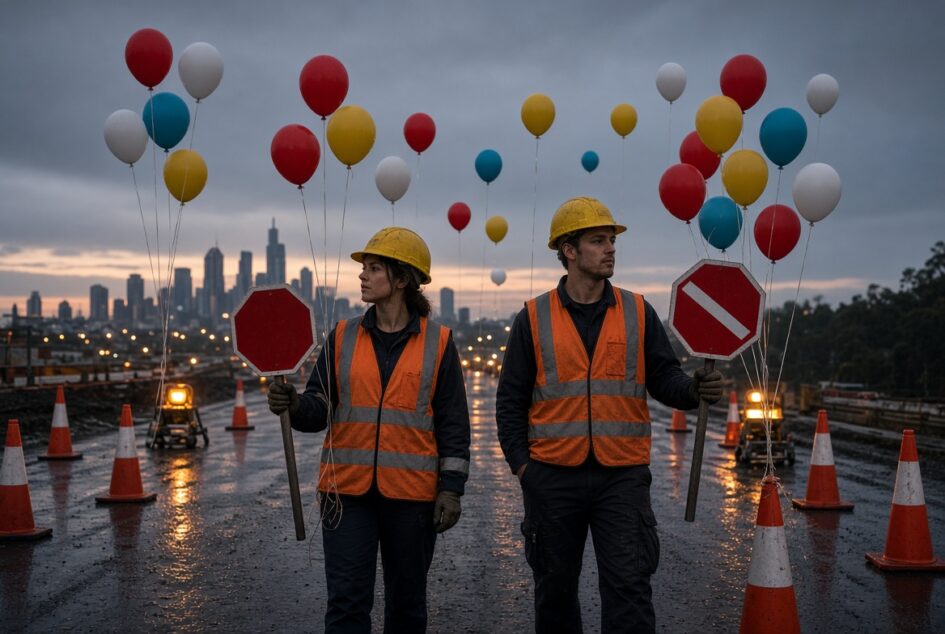
Drive past almost any major roadworks site in Australia and the picture is the same. High-vis vests, orange cones, and young women in hard hats twirling the red-and-white stop/slow bats that have earned them the name lollipop ladies. Some are on their phones. A few have become minor celebrities on TikTok. Almost all of them are paid sums that make a qualified tradie wince.
Bettina Arndt, once a mainstream sex therapist and columnist and now a writer the institutional media prefers to ignore, has been documenting what those bats actually signal. In her Substack essay “The Lollipop Ladies,” she traces the job not to a sudden national passion for traffic management but to a stack of incentives: CFMEU-era penalty rates, overstaffing rules, and gender quotas that let big contractors tick a female-employment box and keep winning government tenders.
Traffic controllers can clear well over $100,000 before night and weekend loadings. John Lloyd, the first Australian Building and Construction Commissioner, has put the base figure around $126,000, with further weekly entitlements on top. Australia deploys two or three times as many controllers per head as the United States, Britain or New Zealand, with no clear evidence the extra bodies buy fewer work-zone deaths. The women are the face. The bill is the story.
That is the mood Labor has spent two terms feeding.
Announcements for women arrive in a steady stream. Men appear mainly as a problem to be managed: the manosphere, toxic masculinity, boys who need re-education.

Dan Repacholi, the government’s Special Envoy for Men’s Health, tours with the Assistant Minister for the Prevention of Family Violence and talks about respect. Victoria briefly created a Minister for Men and Boys, then abolished the portfolio after fourteen weeks.
In September the Commonwealth pulled specialist funding for prostate cancer nurses, the people who support more than 300,000 men living with the country’s most commonly diagnosed cancer, and folded the work toward the McGrath Foundation. Arndt’s verdict was blunt.
Why does this government hate men so much?
BETTINA ARNDT
The numbers underneath the irritation are uglier. Seven men die by suicide in Australia every day, about three-quarters of the total. From 2000 to 2021 the national rate barely moved while the global average fell by more than a third. Arndt’s reporting on the suicide bureaucracy describes a system that answers a male death toll with gender-equity programs for boys, “lived experience” panels dominated by female survivors of attempts, and funding streams that sit inside the National Plan to End Violence Against Women.
As Bettina Arndt wrote: “The men dying by suicide in Australia are not dying because they haven’t learned to cry. They are mainly dying because they’ve lost their children, their homes, their reason to keep going — and the system built to save them is too busy advancing gender equity to notice. Seven men today. Seven tomorrow. The feminist capture of suicide prevention is not an abstraction. It is a body count.”
Situational drivers that keep turning up in the evidence – loss of children, the family law system, financial ruin, nowhere to sleep – are treated as distractions. One Nation’s Senator Tyron Whitten put some of this to Health Department officials in estimates. The answers were evasive. Men, he was told, are “embedded” in the strategy.
Pauline Hanson has been saying a version of this for nearly thirty years, and the Canberra response has been consistent: sneer, then move on. She has called the family law system a machine that denies fathers their children and treats domestic violence allegations as a weapon in property and parenting fights.
Her colleague Malcolm Roberts has described the court as “the slaughterhouse of the nation.” Hanson has sons who have been through the quagmire. A politics lecturer at UNSW recently tried to bury her as “queen of the Australian men’s rights movement.”
The elites sneered. A growing number of men, and a surprising number of women, cheered. Resolve Political Monitor, showed that in May of 2025 seven per cent of men and six per cent of women said they would vote One Nation. By the May 2026 reading that had risen to 22 per cent of men and 24 per cent of women.

Immigration is the headline driver. Gender is the undercurrent.
Men have been dropping out of work and marriage for decades; Arndt’s recent essays argue the inducements have collapsed and the product on offer has changed.
Labor’s answer has been more initiatives for women and more lectures for men. National Party MP Llew O’Brien, now Shadow Special Envoy for Men and Boys, calls it an anti-male government and says the institutions have been captured by people who assume an abuser at the heart of every man.
None of this makes a lollipop lady the villain. Arndt is clear on that. She is the billboard. Behind her sit union rules, procurement quotas, a family law culture Hanson has attacked since 1998, and a suicide system that keeps finding new ways not to talk about the men who die.
With an election coming, the parties that spent a decade treating male grievance as a joke are discovering, too late for comfort, that the joke has a vote.
Further Reading
Politicians Discover Men
https://bettinaarndt.substack.com/p/politicians-discover-men
Australia’s failed suicide policies
https://bettinaarndt.substack.com/p/australias-failed-suicide-policies
The Lollipop Ladies
https://bettinaarndt.substack.com/p/the-lollipop-ladies


Leave a Reply