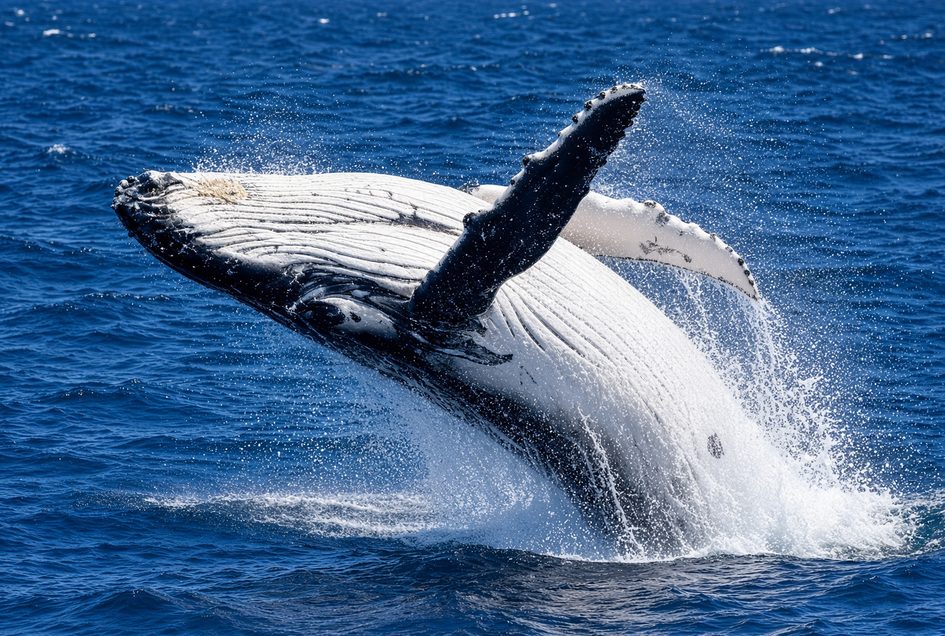
The humpback whale migration up and down the east coast of Australia is one of the great natural wonders of the world.
As November settles over the east coast, the last of the humpbacks are heading south. Mothers with calves, the late travellers, slip past the headlands of the Illawarra and beyond, bound for Antarctic feeding grounds.
For a few more weeks the ocean still offers those sudden, heart-stopping appearances: a fluke rising, a breach that sends spray higher than the cliffs, a spy-hop that feels almost conversational. Then the route goes quiet until next autumn.
Coastal residents treat the season as something close to sacred. People who have watched for years say the animals carry with them a mystic presence, underwater saints on a journey beyond words.
Theirs is a remarkable story of survival and recovery. Historically the spectacle has been threatened by humans twice, first when the animals were hunted to virtual extinction for their oil, and then in more recent times when the Australian government proposed plans to build offshore windfarms directly on their migration route.
The migration up and down the East Coast of Australia extends from May to November as the behemoths travel up from the Antarctic to their breeding grounds off the Queensland coast, and then follow a similar route back with their newborn calves.
At up to 10,000 kilometers, it is one of the longest animal migration routes in the world. Having evolved from land mammals that lived in warm salty waters about 55 million years ago, their migration patterns are believed to have developed to such a length as the animals became separated from their seasonal food sources.
After years of impassioned activism by environmentalists, their killing was outlawed in Australia in 1978.
The whales, which were hunted to near extinction in Australian waters during the 19th and 20th Centuries, have been recovering dramatically in numbers. Their numbers were variously estimated to have crashed to as low as 250 individuals, and have now dramatically recovered, with current estimates placing their population at between 40 and 50,000.
They are believed to be increasing in number by about 10 percent each year, somewhere near the biological maximum for animals this size. Some recent assessments put the population at or above pre-whaling levels. It is one of the clearer wildlife recovery stories of the past half-century. The whales never forgot the route; cultural memory and a long period without harpoons did the rest.
In 2024 Climate Change and Energy Minister Chris Bowen’s government declared an Illawarra Offshore Renewable Energy Area, squarely across the migration corridor used by tens of thousands of whales and calves.
After tens of millions of dollars were squandered in feasibility studies, consultations and the like, and in trying to convince a sceptical public that placing windfarms directly in their path would not harm the animals, the area was reduced and pushed out to some 20 kilometres, on the edge of the continental shelf.
If the offshore windfarms had proceeded despite the intense community hostility, they would have represented an engineering marvel for which Australia is not known.
Early talk of offshore wind delivering capacity at a quoted figure around $10 billion sat uneasily beside the Snowy Hydro 2.0 experience. That project, originally floated by former Prime Minister Malcolm Turnbull at $2 billion, is now assessed at a minimum of $22.2 billion and potentially $25 billion, with completion pushed to late 2029.
This map is courtesy of BlueFloat Energy, an international company vying for business with the Australian government. It is headquartered in Madrid and has an annual revenue in excess of $11 billion.
The corporation has partnered with the Sydney based group Energy Estate to relaunch its South Pacific Offshore Wind Project after the Illawarra region was formally declared a Renewable Energy Zone by the NSW State Minister for Energy earlier this year.
The group held public meetings around the Illawarra this month in what could only be called a promotion gone badly wrong, as the surrounding publicity alerted an already sceptical community to the government’s intentions and spurred hostile media coverage.
Proponents and officials maintained the animals would simply navigate around turbines and cables. Lifelong whale watchers and groups including Sea Shepherd were unconvinced, pointing to underwater noise, entanglement risks from floating mooring systems, vessel traffic, and the sheer volume of animals using the route. Community meetings filled with hostility; Facebook groups swelled; submissions to government inquiries numbered in the thousands.
The commercial interest has since largely evaporated.
BlueFloat Energy, the last remaining serious applicant, withdrew its feasibility licence application as its parent scaled back offshore wind globally.
Equinor and Oceanex had already walked away from the Illawarra and other Australian projects. In January 2026 the government confirmed it would not grant feasibility licences for generation projects in the Illawarra because no application could be progressed.
The zone remains formally declared and is open for research and demonstration licences, but the prospect of a large commercial array in the middle of the migration has stalled. Similar retreats have occurred elsewhere.
The acute local resistance helped make the economics and the politics unattractive.
Sceptics of the broader policy frame note that intermittent wind and solar require extensive subsidies and backup. As Chris Morrison has argued in his recent book Implausible, running modern grids primarily on weather-dependent sources is a high-cost exercise whose true price is routinely understated. Billions have flowed from taxpayers through green-focused foundations and investors into advocacy and the pockets of billionaires, framing the transition as inevitable and low-cost; the practical results have been more expensive and less reliable than advertised.
Whales, by contrast, have managed their own recovery without a ministerial announcement.
The potential destruction of the migration route of Australia’s whales has helped destroy the Labor government’s credentials on environmentalism and came to be seen as a significant breach of public trust. Fortunately for the whales, the government was mugged by reality.
The animals themselves have outlasted the industrial hunt and, so far, the latest industrial proposal.
These majestic, ancient, highly intelligent animals, the subject of myth and legend across multiple human cultures, provoke both deep affection and awe in the Australian public. There are those who think they can hear them in their dreams, as these giant animals, believed to be some of the most intelligent on Earth, pass us by.
The annual spectacle of their magnificent migration is an annual preoccupation for millions of Australians, a phenomenon dating back millions of years of evolution, not just a few decades of human brutality. For now their migration route remains open. The triumph, in a world beset by difficulty, belongs to the whales. And to the many Australians who care so deeply about them.
Whale Images courtesy of the Whale and Wildlife Shellharbour Facebook page and Lucy Abarcia, an enthusiastic supporter of Shellharbour Wild, a prominent eco-tourism and whale-watching cruise company.