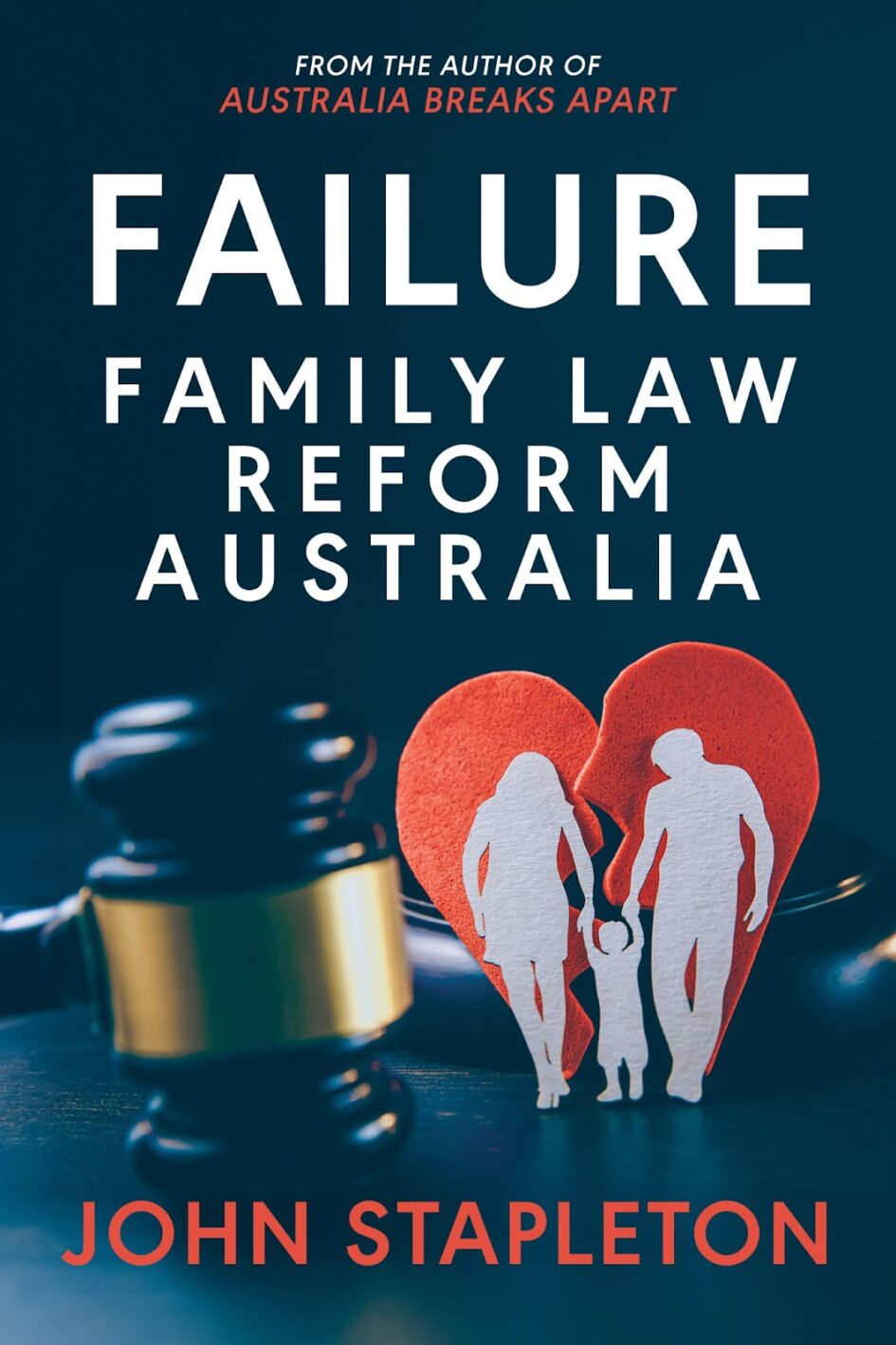
50th Anniversary of the Family Law Act.
Warnings that there were serious problems with the court came early. In 1985, only a decade after the court’s establishment, Australia’s proud old weekly The Bulletin ran a story on its front cover: “The Devastation Of Divorce: Why Men Hurt The Most”.
It was written by Bettina Arndt, for many years virtually the only columnist in the Australian media to show any sympathy or understanding of men’s issues. In an era when the media was transfixed by latter-day feminism and masculinity was out of vogue, Arndt stood out for her courage to be different. Ridiculed by her liberal critics as an old fashioned right winger, she was a hero to separated men around the country.
On one occasion, almost 20 years after her Bulletin article, she gave me a lift out to western Sydney for a public meeting. When we alighted from the vehicle she was surrounded by men saying how much they appreciated her work. Sad, she commented, that I have become a celebrity to these people just for showing a bit of sympathy.
Her Bulletin article began with a series of quotes: “Total devastation”; “like being hit on the head by a piece of four by two”; “falling apart”; “shattered”. Arndt went on to disclose the details of research by Family Court counsellor Peter Jordan showing the crippling effects of divorce and separation on men’s emotional and physical health.
It contained the first published Australian research focusing on male reaction to divorce and confirmed overseas evidence of men’s vulnerability in the breakdown of a marriage. In a world where men were characterised as controlled, unemotional decision makers the research held a number of surprises, including that only 19 percent of divorces were initiated by men, contradicting the image of unfaithful, feckless men.
The report also showed that upon separation most men experienced emotional and physical symptoms normally associated with extreme grief, including crying and sleeplessness, and also had difficulty concentrating at work.
They often suffered loneliness and social isolation.
While more than half of the men surveyed attempted reconciliation after separation, only seven percent of women bothered trying. Up to two years after divorce most men still felt they had been dumped, a third felt the divorce was a horrible mistake and a third still felt they would never get over the breakup.
Peter Jordan decided to conduct research into the effects of divorce on men after counselling his first 21 males involved in separation proceedings and discovering that 20 of them were bewildered, angry and often in tears.
“I was surprised because I expected the women to be the ones who were distressed,” he said. “Here were these men desperately wanting the marriage to continue, pleading, crying, offering anything, promising anything to persuade their wives to come back. I thought: ‘What is going on here?’ and went looking for research on male reactions to divorce and found very little had been done.”
The research, involving 168 men between one and two years after separation, were contacted through the Brisbane registry of the Family Court. Most were in their late 20s or 30s.
One respondent said: “I always considered myself a pretty independent guy. I have a staff of six under me at work and they know I’m boss. I never realised how much I miss my kids and my old house and even the arguments with my wife. I feel like I’m falling apart.”
Another said: “The turmoil made me sick. The self-hate ruined my appetite and sleep. The ghost of the relationship lived on in the inanimate objects around me. I wanted to run away but felt trapped… I wanted to be alone but felt lonely. The same rotten unanswerable questions kept coming up over and over. Was I really that bad to live with? What was wrong with me or was it her?”
Arndt wrote that it was only when the marriage ended many men realised the extent and intensity of their attachments to the marriage, their wife and their children. The man was often confused to discover the depth of his feelings and searched blindly for an explanation.
Jordan’s research found men experienced a range of problems in coping after separation, from difficulties at work, financial and domestic problems – house cleaning, washing, shopping and so on. And most of all, social isolation – difficulties in making new friends, developing and maintaining new relationships, finding people to talk with and feel close to.
There would be no policy response from the Australian government. Parliament paid no heed whatsoever to the mounting evidence of the family law system’s consequences on fathers. The stories of father’s treatment by the Family Court and concern over the impacts on children of losing the male parent from their daily lives were ignored.
As the Bulletin story demonstrated so well, knowledge of the harm being done to fathers, and consequently to their children and to the community at large by the Family Court of Australia through its religious adherence to sole-mother custody and mistreatment of fathers had been well known for decades. Yet politicians and political parties ignored their pain. How different this country would be if politicians took the same oath as medical practitioners – “do no harm”.
Back in 1985, 21 years before the Howard government chose to act, or pretend to act, on child custody, Arndt recorded that many men felt unfairly treated by the court system.
“Men often resent decisions made about property and alimony, are frustrated at their inability to prevent an unwanted divorce and are particularly bitter about that most difficult of issues – care and responsibility for their children.”
Far from the image of distant and uncaring fathers painted by feminist lobby groups, Jordan found 98 percent claimed strong feelings for them and 91 percent did not want to be separated from them. Interestingly, Arndt quoted novelist Al Alvarez, who I had interviewed in London during the 1980s. He was a lovely writer, author of that classic of my youth, The Savage God, a study of suicide and Sylvia Plath. As he wrote so perceptively in his early 1980s book Life After Marriage: “To leave a husband or a wife whom one no longer loves may be sane and natural but there is no easy way to divorce a child and, until shared custody becomes the standard practice, no marriage counselling or social reform or enlightened legislation will cure the breaking of the heart.”