
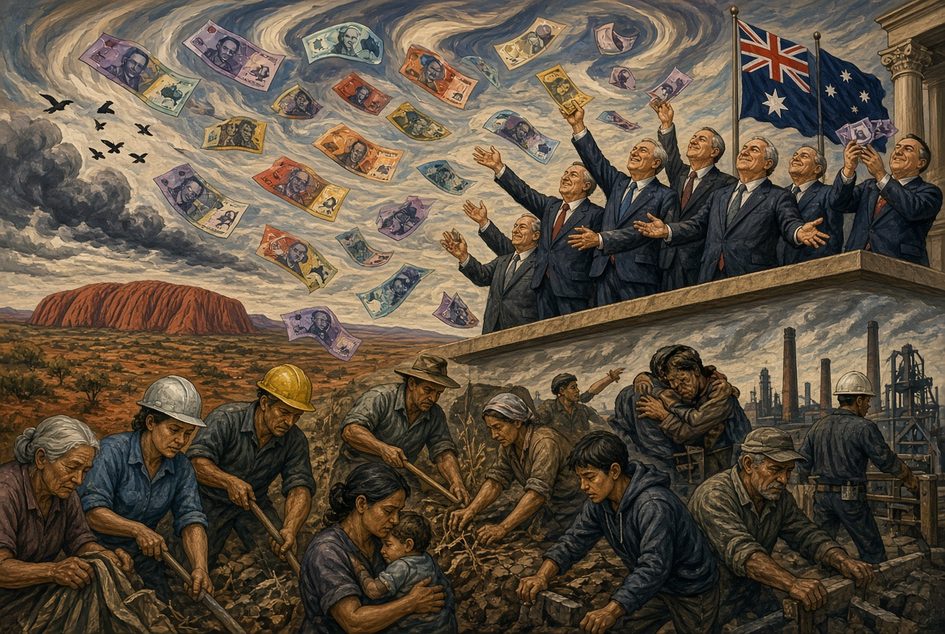
Scott Kuru has become one of the sharper voices arguing that Australian governments are mismanaging the economy through relentless taxation and policies that punish effort. The property adviser and YouTuber repeatedly shows how households and small businesses are squeezed from every side as the cost-of-living crisis grinds on. Complaints about groceries, fuel, rents, insurance and mortgages have only grown louder as real incomes lag.
Kuru draws on the Henry Tax Review, which counted 125 taxes across federal, state and local levels. Governments recently collected roughly $892.5 billion, more than $30,000 per person, yet only about ten of those taxes raise most of the revenue. The rest, he says, exist mainly to “gnaw at your money from every side.”
The Australian Tax Office’s rapacious behaviour acts as a whip across the backs of Australian workers. Meanwhile every single person in the country can see with their own eyes the lavish lifestyles of the political class and the gross waste of their taxes on numerous pie-in-the-sky schemes which benefit them not one jot. Any examination of any of Australia’s many Byzantine bureaucracies shows waste, incompetence and ineptitude.
They’ve been exposed for the grifters and pathetic economic managers that they are time and time again, yet seemingly the great majority of Australia’s politicians simply don’t care.
“You are being taxed when you earn, taxed when you spend and soon taxed even harder when you invest. It is time someone laid out exactly how the system is stacked against you.”
SCOTT KURU
The layering is relentless: income tax, Medicare levy, GST, capital gains tax, stamp duty, land tax, council rates, fuel excise with GST stacked on top, payroll tax for simply employing people, and more. Bracket creep does the rest.
Tax brackets are not indexed, so a pay rise that merely matches inflation still pushes more income into higher rates. Australia already takes a higher average share of workers’ pay in income tax than the OECD average.
Compliance alone costs the economy around $60 billion a year in accountants, software and lost time. That is insane.
Australia already takes a higher average share of workers’ pay in income tax than the OECD average.
Small Business and Forced Returns to Work

Small businesses, which employ millions, are under sustained pressure.
Closures have run at high rates while costs rise; fuel subsidies gone, higher wage and super obligations, endless red tape, and card-fee changes that simply get built into higher shelf prices. Kuru has described some of the policy moves as the government making life “much harder for the remaining businesses.”
Retirees are another flashpoint. People who planned to stop work are calling old bosses because fuel, mortgages, rents, insurance and food have made retirement unaffordable.
Kuru has highlighted Treasurer Jim Chalmers telling households not to “count on” further relief. Oil-market disruptions feed straight through freight costs into supermarket prices, keeping inflation sticky and interest rates elevated.
Debt, Recession Warnings and Housing

Federal gross debt has crossed $1 trillion. Combined federal, state and territory debt is forecast to push toward or beyond $2 trillion by the end of the decade. The interest bill is rising sharply, tens of billions a year that would be better used to fund hospitals, housing or tax relief.
Kuru traces the structural deficit back through mining-boom revenue treated as permanent and successive stimulus packages.
Headline GDP figures mask the household squeeze: per-capita weakness, real wages that have struggled or gone backwards, and productivity problems. Institutions such as Deloitte, the International Monetary Fund and the OECD have issued warnings even while official unemployment stays relatively low.
Housing values are already down several percent from recent peaks in many markets, with longer selling times and first-home buyers who entered on low deposits now underwater on paper. As their home is their primary investment, many in Australia’s savaged middle class now feel poor.
Mortgage stress remains high. Kuru has discussed crash risks and corrections while noting chronic undersupply still provides a longer-term floor in many areas. Policy changes around negative gearing and capital gains have provoked a visceral response, making life for small business owners, investors and renters yet more difficult.
What Australians Can Expect in the Coming Months

Kuru’s recent output points to more pressure, not quick relief. Energy and fuel costs, amplified by global supply disruptions, will keep feeding into freight, food and broader inflation. Forecasts have inflation remaining elevated for some time, limiting the chance of meaningful rate cuts that would ease mortgages.
Tax changes already flagged, ]including capital-gains adjustments that reduce the discount for many assets, further targeting of trusts, and exit-related rules, will start to bite. Bracket creep continues automatically. Small-business conditions stay fragile. Housing corrections already under way are likely to persist in the near term even as population growth and undersupply provide some support. Debt-servicing costs will keep rising as cheap pandemic-era borrowing rolls over at higher rates, crowding out other spending and increasing the pressure for more revenue.
Kuru’s core message is blunt: the tax system’s complexity and the government’s spending and policy choices are actively crushing household budgets and business viability.
The next few months are likely to bring more of the same: elevated living costs, limited official relief, ongoing housing-market adjustments, and a rising interest bill on public debt that ordinary Australians will ultimately service.
More Information
