
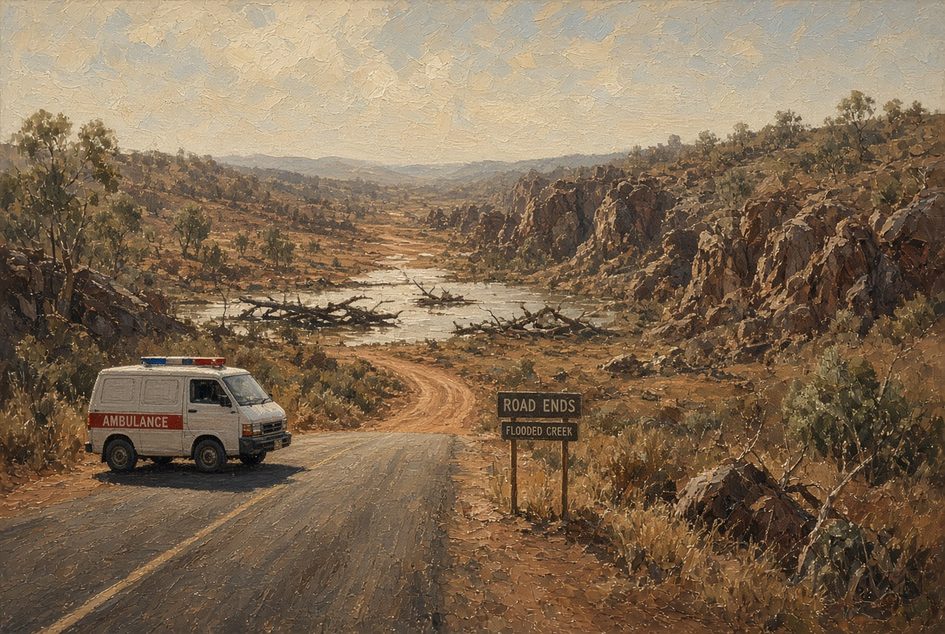
Ten separate stories. Same bloody problem: Nobody tells the Australians affected.
1. The Roads Vanished, and 000 Can’t Get You
September 2020. The Queensland Roads Team swapped the old Baseline Roads and Tracks (BRAT) dataset for the new Queensland Roads and Tracks (QRT) system. Their own metadata says segments were excluded for “data management purposes.”
Not defined anywhere. No list. No notice. No register. Just a shrug in a spreadsheet.
Here’s the bit that kills you: 000 does get your phone’s GPS. The dispatcher sees a dot. Knows you’re there. Sends the vehicle. It drives to the nearest gazetted road and stops. Because between that road and your dot there’s a flooded creek, a fallen tree, 20 kilometres of unmarked track through bush, and a gorge. It’s not a road. It’s wilderness.
And the dispatcher doesn’t know the track exists. Because it was cut in 2020 for “data management purposes.” Now they say we use local knowledge and send a vehicle first, then the chopper. But the vehicle hits the same wall. Then the chopper, if it can. If the weather’s right. If they’ve got one.
QPS confirmed in writing, 10 October 2026: some roads in the electorate of Leichhardt don’t exist in their mapping. Flinders Shire had to manually push its own road data in 2023. In Leichhardt, nobody did that.
2. Starlink: Telstra’s Fix for Its Own Coverage Gap, Minus the 000

Here’s the kicker. Telstra’s network covers about 28 per cent of the country. Over sixty per cent has no cellular coverage. Telstra knows this. They’ve always known this.
So in January 2025 they signed a deal with Starlink to do the job their own towers can’t. Satellite-to-mobile. Fill the gaps. Their words: “provide better coverage from coast to coast, especially for those in regional and remote areas.”
And it works. Sort of. You can send a text. You can’t make a call. You can’t ring 000.
Telstra’s own site: “You can’t call Triple Zero from a Telstra Satellite service.” Their Satellite Messaging: “Cannot contact 000. Do not rely on it in a life-threatening emergency.” Vodafone: 000 over WiFi “may not connect to the correct location.” The government’s Triple Zero page: without mobile service, you can’t reach 000.
So the suits at Telstra looked at the sixty per cent their network doesn’t reach, said “we’ll get Starlink to do that job,” and handed the blokes out bush a text message service. No voice. No 000. No location to dispatch. Just a text. “G’day, I’ve got a snake in my foot.” To whom? No one.
And the 552,000 Starlink dish subscribers, nearly doubled in a year, same problem. Netflix, yes. 000, no.
Google it: “Can you call 000 emergency from Starlink in Queensland?” Answer: NO. On the carriers’ websites. On the government’s website. Not a secret.
Senate’s Triple Zero report: 21 September 2026. Eleven recommendations. Government response due March 2027. Until then, the bloke with the dish and the snake in his foot is on his own.
3. The Dams Are Down for Works

Macdonald at 39%. North Pine at 48%. Both at their lowest in years, and they’ll stay there through the next few wets. Macdonald’s getting a brand-new wall and spillway. The old ones being demolished, a cofferdam holding back the water. North Pine’s getting 64 massive anchors drilled into the wall to add 95,000 tonnes of “don’t fall down.”
The $545M program runs to about 2029. The water comes back. It’s standard engineering, can’t work on a dam wall with the reservoir full. Same as draining a pool to retile it. Your neighbour’s got a ladder and a bucket. Seqwater’s got a cofferdam and a four-year timeline.
But going into another wet with two of the grid’s dams at their lowest, and the IPA saying there’s not enough storage, the margin’s thin. No new dam at a new site is being built. One site’s being looked at. That’s it. That’s the whole “new storage” plan. A look.
4. The Sewerage Pipe’s Been in the Ground Since the 2000s

Three plants, Bundamba, Gibson Island, Luggage Point, can pump purified recycled water straight into Wivenhoe Dam. Blends with rainwater, goes through conventional treatment at Mount Crosby, hits the taps. State law says it can’t go in direct, has to go through the dam first. Which is a bit like saying you can eat the cake but you have to put it in the fridge first.
They’re offline now because the dams are full enough. Switch on when grid levels drop below 40 to 60%. Built, tested, permanent. Drought insurance from the Millennium Drought era. The same era as the “Y2K is gonna end the world” panic, for those keeping score.
It’s just sitting there. Like a spare tyre under the ute. You hope you never need it. But it’s there. And the pipe’s already in the ground.
5. The Land’s Been Going Back for 30 Years

Since 1991, over 6 million hectares returned as freehold Aboriginal or Islander land under the state Acts. Add 212 native title determinations as of April 2024, covering about a third of the state. Most is non-exclusive — coexists with pastoral leases and mining tenements. Your cattle can still graze. Your mining permit’s still valid. But the Traditional Owners’ name’s on the title now.
Exclusive title’s been granted in big blocks. The 2022 Kaanju and Kaantju determinations: 750,000 hectares in Cape York. Kabi Kabi, June 2024: 10,000 square kilometres in South East Queensland. First of its kind down there.
It’s a federal court process. Three decades of building. Not one decision by one government at one time. But the rate’s picked up in the last decade, and exclusive land’s becoming more common. The suits in Brisbane didn’t do this. The courts did. The governments just signed the papers.
6. The Wind’s Blowing and the Sun’s Shining

1,500 megawatts of renewables in 2015. Well over 5,000 by 2025. MacIntyre — 923 MW, October 2024 — biggest wind farm in the country. Chinchilla — 400 MW — biggest solar. Batteries stacking up at Tarong, Greenbank, Brendale, Swanbank, Ulinda Park. State targeting 70 per cent renewable by 2030.
It’s private capital doing the building. Snowy, AGL, Macquarie, Ormat. The state sets the targets and the grid rules. Doesn’t own the farms. Doesn’t operate them. Just points at the map and says “put it there.”
The wind’s blowing whether you like it or not. The sun’s shining whether you like it or not. The only question is whether you’re paying for it or watching someone else’s investment portfolio go up.
7. The Cops Are Leaving, and the Rural Stations Are Shrinking

709 officers walked in FY24–25. Attrition hit 5.7% — double the norm. 895 vacancies. 650 on long-term psych leave. The Commissioner’s own review called it “burnout.” Which is a polite word for “we’re all about to have a mental health event.”
Since Crisafulli took over: 1,805 new cops sworn in, attrition down to 2.6%, headcount at a record 13,000-plus. The bleeding’s slowed. The suits are happy. The spreadsheet looks better.
But the rural stations didn’t wait for the numbers to come back. What’s happening ain’t closures, it’s reduced hours. Childers closed Fridays. Mount Morgan closed weekends. Imbil closed four days a week. Mundubbera open 2.5 days. Laura. Single officer since 1877, hours “varies, please call to confirm.” Which is what you say when you don’t know either.
The station’s on the register. The door’s there. Turn up on a closed day and you’re on your own. Same as closed. Just harder to complain about.
8. The Public Sector Grew by 47,000 Jobs

232,554 full-time equivalent in March 2020. 279,577 in March 2026. Up 47,023. Headcount including part-timers: up 55,147. Health took more than half: +26,796. Education: +5,431. Everything else, police, corrections, fire, admin, TAFE, +14,796.
The biggest jump was 2023–24, up 11,702 in a single year. The ABC flagged corporate roles growing faster than frontline that year. The government says 99.6% of the latest 8,693 was frontline. Both can be true. Depends which year you look at and which spreadsheet you trust.
Population up 8.85%. Public sector up 20%. Most of it health and education, already underfunded before 2020. Population growth, post-COVID expansion, school buildings, police recruitment. Six years of compounding. Not one decision. Just the slow creep of a state that keeps growing faster than it can staff itself.
9. The Businesses Are Churning Like a Washing Machine

Up from about 460,000 to roughly 543,000. Small business grew 9.5%, above the national average. The suits are pleased. The headline reads “Queensland business boom.”
But the churn is brutal. 70,000 shut up shop every year. 80,000-plus open. Net’s positive, but the bloke on the corner in 2021? Probably gone. Replaced by a different bloke with a different ABN.
And who’s “starting” all these new ones? Mostly a bloke with an ABN and a ute. 64.6% of Queensland businesses don’t employ a soul. 77% of new ABNs in 2026 were sole traders. ABN registrations measure intent, not trading. Register one Tuesday, never do a dollar of work.
Survival rate: 64.3%, worst in the country. New sole proprietors: 41.5%. Less than half made it. Zombie businesses propped up by JobKeeper finally kicked the bucket once the support ran out.
“Queensland adds 19,000 businesses”. When three-quarters are a person with an ABN number, that’s not 19,000 shopfronts. It’s 19,000 blokes getting a number and calling it a business.
10. The New Estates Have to Be Walkable, and 90,000 More People Are Moving In

Grid streets, 250-metre max blocks, footpaths, trees every 15 metres, park within 400 metres. New subdivisions only. Doesn’t touch existing estates. Doesn’t touch rural land. Doesn’t make anyone move. Voluntary. Not a mandate. Just a planning standard for the next estate in Brisbane or the Gold Coast.
And the reason there’s a next estate? Up 92,927 people in a year. Biggest interstate gain in the country, mostly Sydney blokes whose rent’s made them lose the plot. Brits lead the overseas charge. 26,200 over five years, and the Sunshine Coast is basically Cornwall. South Africans heading for the mining towns. Japan’s got a weird grip on Cairns — a long-standing diaspora and tourism link that still stands out in a regional city. PNG, 56% come straight down the coast: most Papua New Guineans in Australia end up in Queensland, many arriving via the north across the Torres Strait into the Far North rather than through the southern cities.
Logan, an infamous Brisbane suburb, has got 73 countries.
The suits set the caps. The market sets the destinations. The blokes just move. And that’s the connective tissue, why the public sector’s up 47,000, why the dams need new walls, why the wind farms are going up. 90,000 more people a year in the Queensland washing machine.
My conclusion for Queensland is the bush is disappearing, less safe, more expensive. The born Australians are out of business. The city will be drinking crap, eating imported printed food, powered by nothing. But don’t panic, you will be living in walkable neighbourhoods.
What’s going on in your neck of the woods?
Jason Clark
Cape York, Queensland.

