
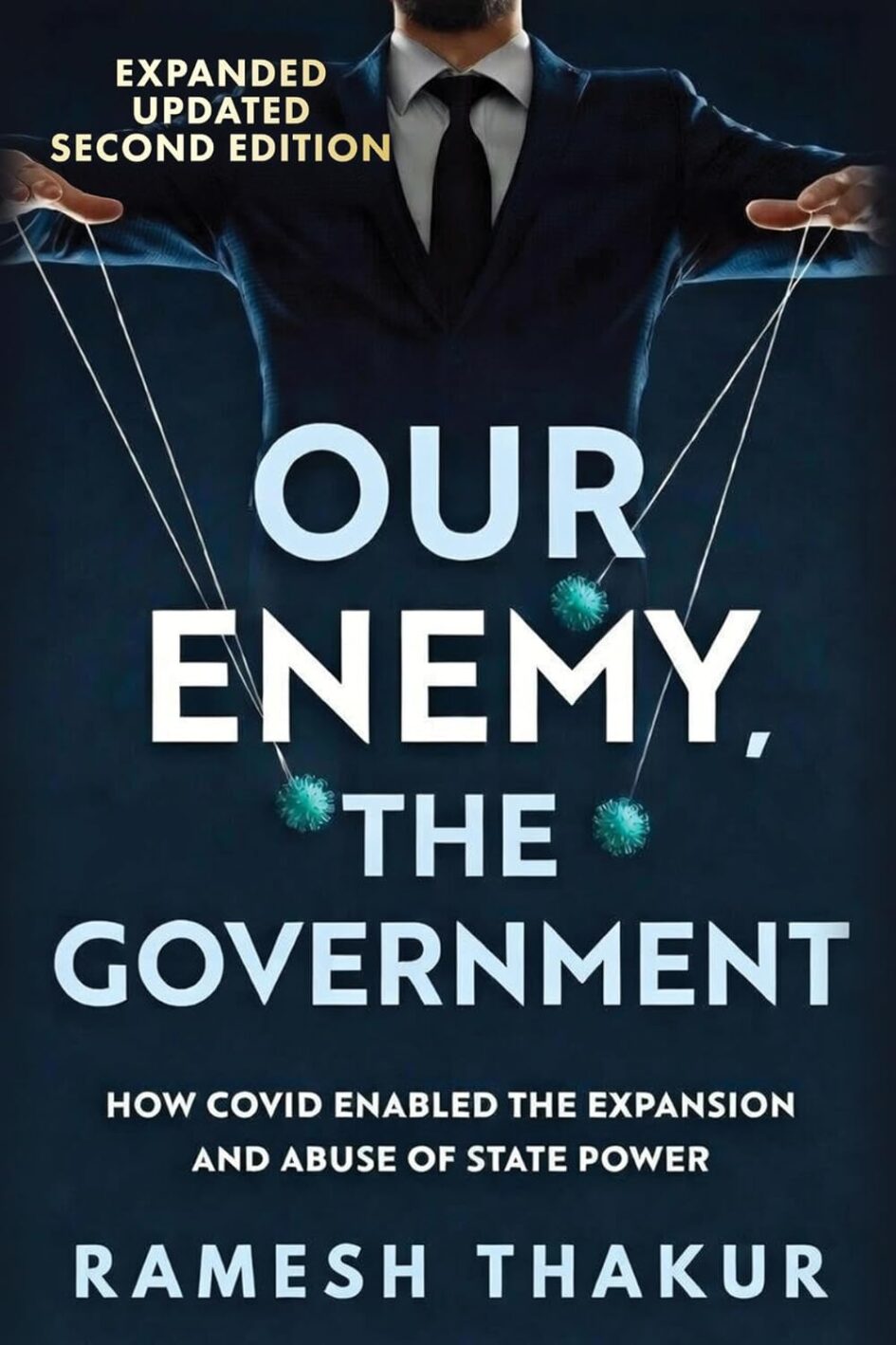
Professor Ramesh Thakur, one of Australia’s most esteemed academics, will be on Cafe Locked Out with John Stapleton and Michael Gray Griffith. It will be streamed at 10am Australian Eastern Time and also be available on X, YouTube, Rumble, Facebook and Substack.
A Sense of Place has just published the Revised and Expanded Second Edition of Our Government The Enemy.
Thakur is also co-author of the The Right to Health Sovereignty: Policy Report, published by the Brownstone Institute in America and launched worldwide this month. The book draws on decades of experience with the World Health Organization (WHO), the report critiques mission creep, over-reliance on earmarked funding from private donors, centralised emergency exceptionalism, and the erosion of individual agency and state responsibility. It contrasts early WHO successes (like smallpox eradication) with later shifts toward politicized, commodity-driven approaches that neglected high-burden diseases, basic health systems, and established public health ethics.
A WORLD IN PANIC: EXTRACT FROM OUR ENEMY THE GOVERNMENT
Let us begin with the deep history that followed the initial lockdowns.What follows are my
initial postings and intuitions from early 2020 as I tried to work out the extent to which the
panic response was justified.
Coronavirus pandemic: sceptical question marks make for better policy than excitable
exclamation marks. When did the world’s media and politicians become collective versions
of Lance Corporal Jones in the British comedy series Dad’s Army, screaming “Don’t panic!
Don’t panic!”?
Colour me contrarian, but since the 2003 Iraq war, my working motto has been: when you
come across excitable exclamation marks, substitute sceptical question marks and you’ll
usually be right.
According to World Life Expectancy, Australia’s annual death toll is around 170,000. Heart
disease kills more than 23,000 people, flu and pneumonia over 4,000, and road fatalities
around 1,300. As at 26 March 2020, about 40,000 Australians had died from all causes. As
of that date, only 12 had died with the coronavirus.Led by the media, panic set in and drove
public policy before the data were collected.
For most people, Covid-19 would turn out to be no worse than seasonal flu. The crisis
escalated with an Imperial College study released on 16 March which described Covid-19 as
“a virus with comparable lethality to H1N1 influenza in 1918” (the Spanish flu that killed
upwards of 50 million people).
Without an aggressive suppression strategy of prolonged lockdown, the modellers warned, it
could cause 500,000 deaths in the UK and 2.2 million in the US. This prompted Prime
Minister Boris Johnson to abandon the initial herd immunity approach and impose a drastic
nationwide lockdown. Other governments were soon infected by the same panic virus. The
favoured strategy became to prioritise citizens’ health over the nation’s economy.
As total lockdown led to economic shutdown, the pain was alleviated through industry
bailouts and social benefit packages.
To kill the virus, must we kill the economy?
In earlier flu epidemics – Asian Flu 1956–58, Hong Kong Flu 1968, SARS 2003, avian flu
2008, swine flu 2009 – the numbers infected and killed were sufficient to produce a severe
impact on society. Yet governments did not shut down their countries, destroy their
economies, or jeopardise their way of life. People suffered but endured. This too shall pass.
In responding to an epidemic, there is a trade-off between public health and economic
stability. It is the duty of health professionals to focus solely on the former. It is the
responsibility of governments to balance the two and find the social fulcrum: the sweet spot
between dangerous complacency, alarmist panic, and reasonable precautions.
The injunction to first do no harm implies that governments should be wary of prolonged
economic lockdowns: the cure might indeed be worse than the disease.Public policy must be
based on a balance of risks and benefits, often amidst uncertainty, incomplete information,
and unintended consequences.
The health of citizens and the health of the national economy are closely connected. A
healthy economy requires a healthy workforce, and most wealthy countries have superior
public health systems precisely because strong economies allow investment in health
infrastructure.In the US, people at risk from comorbidities totalled 70–80 million. At even a
1% excess fatality rate in this group caused by shortages from economic shutdowns,
another 750,000 Americans would die.
For those who were not elderly, the mortality rate after infection was about equal to the risk
of dying from all other causes. Layoffs and income losses would also cause a spike in
mental health problems and suicides. Prolonged house-bound isolation was already
contributing to rises in domestic violence.
On the basis of the existing data, Stanford professors Eran Bendavid and Jay Bhattacharya
concluded that the Covid-19 mortality rate could be as low as 0.01% – one-tenth the average
flu mortality rate.
“Such a low death rate would be cause for optimism,” they wrote. “A universal quarantine
may not be worth the costs it imposes on the economy, community and individual mental
and physical health.”
The sensible strategy would have been to isolate the elderly and vulnerable and let everyone
else get on with their lives. Dr David L. Katz of Yale called this a “vertical interdiction”
strategy, as opposed to the “horizontal interdiction” of mass social distancing. The end result
would have been herd immunity for the population at large, without the enormous social and
economic costs we are still living with today.
Influenza and pneumonia cause 3.2 million deaths worldwide annually. If each case were
tallied daily on the front page of every newspaper, a similar panic would arise. Road
accidents kill another 1.3 million a year. Sensibly, we judge the resulting disruption to
everyday life to be too high a price to pay.
Life and death is part of an eternal cycle. The rational approach is to take sensible
precautions, carry on calmly, and put in place emergency measures only after the facts are
in – while retaining the flexibility to adjust policy in line with the evolving evidence.
As we all now know, Australia did not take the sensible path. Its response to Covid was one
of the worst if not the worst in the world. Vainglorious politicians, aided and abetted by hysterical media
coverage, harangued the population daily. At one point, half the population was locked
down, unnecessarily. The damage done by those decisions still reverberates through many
Australian lives. To this day, the government has done little but cover up its mistakes,
refusing to admit fault or apologise.
Leave a Reply