

Walk a Perth street, enter a hardware store, queue at a stadium gate or present a driver’s licence and the same technology may already be reading your face. This month Western Australia Police reported that an Australia-first live facial recognition trial had scanned more than 905,000 faces in three months.
The marked vans, first rolled out on 22 June, have been used 77 times across 36 metropolitan and regional sites, from Midland Gate and Northbridge to Geraldton. Police say the system generated 209 alerts, produced 79 arrests — 36 of them on outstanding warrants — and flagged 114 registered sex offenders for engagement.
Eight alerts were wrong, a rate they put at 0.0009 per cent. Commissioner Col Blanch calls the vans “highly visible” deterrence. Critics call them something else: the moment public space itself became a watchlist.
Western Australia’s extended facial recognition trial scanned more than 130,000 faces in just one week, highlighting concerns over mass biometric surveillance. As the program continues, questions are mounting over privacy, accuracy, and safeguards.
TOTT News
Surveillance does not only record behaviour. It changes it. Decades of social psychology, from Bentham’s panopticon to modern studies of CCTV and workplace monitoring, show the same first movement: people become more careful, more polite, more visible in the approved way. They take the long way around the van. They put the phone away. They lower their voice at the protest and their hood at the gate. Compliance is cheap. It costs only a little of the self, and most people will pay it rather than be stopped, scanned, or embarrassed in a shopping aisle. That is the official dividend. A watched public is, on average, a quieter public.
The trouble is what the average conceals. Human beings are not only rule-followers. They are animals with a sense of territory and a low tolerance for being permanently assessed. In the wild an animal that is being watched is about to be eaten. When the watching never switches off — street, store, stadium, licence photo — the inner account changes. The citizen stops asking “Am I doing something wrong?” and starts asking “Am I allowed to exist here unseen?” Shame and caution harden into resentment.
Some withdraw. Some perform innocence so hard it becomes a kind of lie. A few stop calculating altogether.

You can predict the herd. You cannot always predict the animal that believes the paddock has become a kill chute. A person who feels cowed, catalogued and without exit does not reliably become a better subject. They become less legible. They duck the camera, split the group, stop carrying ID, stop shopping where the scanners are, or they do the opposite: they test the fence.
History is full of systems that bought short-term order and harvested long-term volatility. A society that scans 130,000 faces in a week should not be surprised if some of those faces learn to go blank — or, one day, to do something the algorithm did not have a box for.
That first-week figure, reported as the trial pushed into Geraldton after Perth and Fremantle, is the number that made the scale impossible to ignore. One hundred and thirty thousand faces in seven days is not a handful of suspects being checked. It is a crowd being processed.
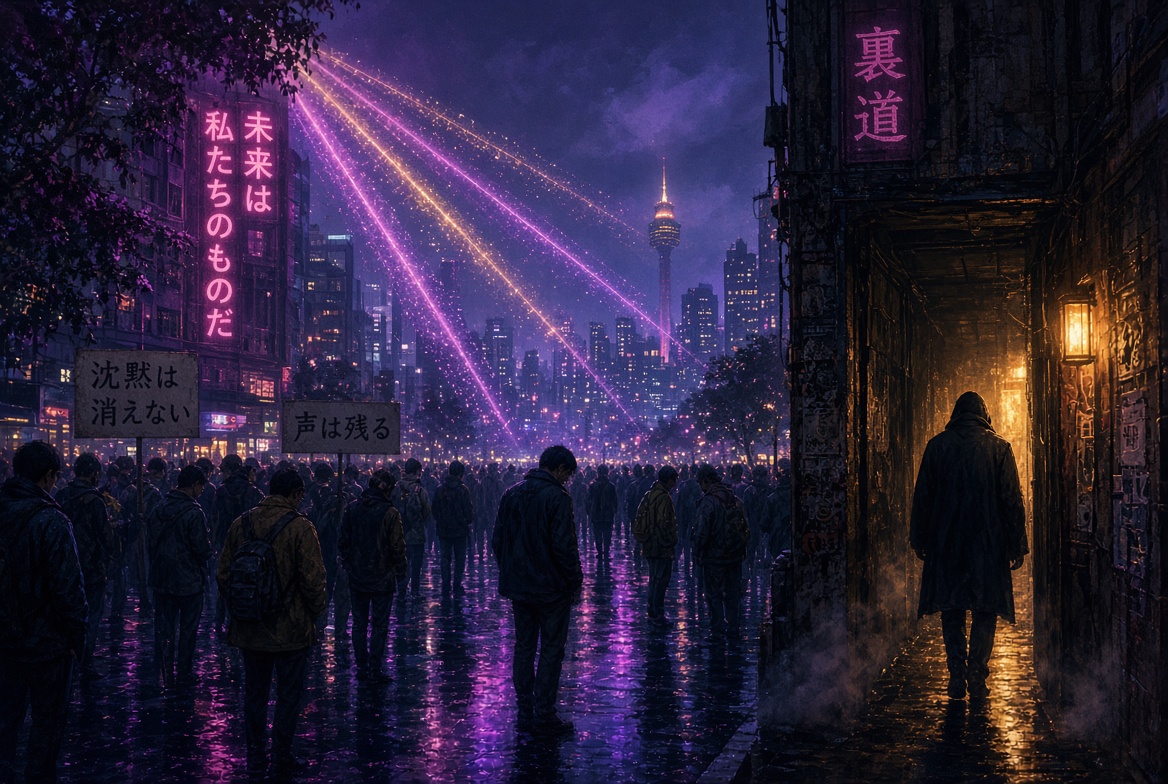
Police say non-matches are pixelated and discarded. The public argument is whether a system that must look at everyone in order to find a few can still be described as targeted.
The technology is NEC’s NeoFace, mounted on or near marked vans. Faces in the crowd are compared in real time with a predetermined alert list of wanted people, registered offenders and missing persons. Nothing in the architecture stops the watchlist being extended to political dissidents. That is a policy choice, not a technical limit.
Formal evaluation of the five-month trial is still to come. Ethicists note the published figures do not show who was missed, nor how the system performed across skin tone, age or lighting — even as some false alerts were attributed to darker skin and poor reference photos.

What is happening on WA streets is no longer an isolated experiment. In February 2026 the Administrative Review Tribunal found Bunnings was entitled, without customer consent, to use facial recognition to identify people linked to violence, intimidation and high-value theft.
The Privacy Commissioner had earlier found the chain’s 2018–21 trial across 62 stores breached the Privacy Act. The tribunal set aside the core collection finding but still held Bunnings failed on notice and privacy policy. Bunnings is now preparing a national rollout with new signage and governance.
That ruling opened a door. Coles has run a small proof-of-concept. Woolworths has tested the technology in New Zealand and is weighing Australian use. Kmart, by contrast, was found in 2025 to have broken the law by scanning every customer at 28 stores to fight refund fraud.

The commercial cameras sit alongside a quieter national build. The National Driver Licence Facial Recognition Solution, long delayed, became operational from late 2025. Western Australia and South Australia connected first. New South Wales has now legislated to share licence and photo-card images through the Commonwealth face-matching system. Passport and licence photos can be checked through the Face Verification Service.
What is new is the combination: live street scanning, watchlists, and a national licence-photo spine. Ministers say only people “who represent a risk” are identified. The numbers tell a broader story.Hundreds of thousands of faces are processed so that a few hundred alerts can be generated. Most of those faces belong to people who will never be spoken to.
The system’s promise is speed and safety. Its cost is a public in which anonymity is no longer assumed, and individuality is just another input.
Further Reading
West Australia Police. Official Explainer:
https://www.wa.gov.au/organisation/western-australia-police-force/live-facial-recognition-technology
This months Western Australia Police Announcement:
https://www.wa.gov.au/government/announcements/overt-live-facial-recognition-trial-update

Leave a Reply